
Twist-lock surface conditioning discs provide industrial professionals with a quick-change solution for rust removal, surface preparation, and metal polishing applications. This comprehensive guide covers proper disc selection, attachment methods, operational techniques, and safety protocols to maximize efficiency in metalworking, fabrication, and maintenance operations. Understanding the mechanical advantages of twist-lock systems versus traditional mounting methods enables procurement managers and operators to optimize abrasive tooling investments while reducing changeover time by up to 75% compared to threaded or adhesive-backed alternatives.
Twist-Lock Surface Conditioning Disc Technology
Twist-Lock Attachment Mechanism vs. Traditional Mounting Systems
The twist-lock attachment system represents a fundamental advancement in abrasive disc mounting technology. Unlike threaded arbor discs requiring multi-turn installation or PSA (pressure-sensitive adhesive) backing pads that degrade under heat exposure, twist-lock mechanisms utilize a quarter-turn bayonet-style connection. This design incorporates raised lugs on the disc backing that engage with corresponding slots in a quick-change backing pad, creating a secure mechanical interlock.
Operational Advantages:
- Tool Changeover Efficiency: Disc replacement completes in 3-5 seconds versus 30-45 seconds for threaded systems
- Torque Transmission: Direct mechanical engagement eliminates slippage common in adhesive systems under high-load conditions
- Heat Resistance: Metal-to-metal contact maintains integrity at temperatures exceeding 200°F, where adhesive bonds fail
- Equipment Compatibility: Standard 5/8″-11 threaded backing pads fit most 4.5″ and 5″ angle grinders, plus die grinders with appropriate adapters
The backing pad’s rigid construction—typically fiber-reinforced resin rated to 13,000 RPM—provides consistent support across the disc surface, preventing edge cupping that causes uneven wear patterns. This mechanical stability becomes critical during aggressive rust removal, where inconsistent pressure creates gouging.
Abrasive Material Composition and Grit Classification
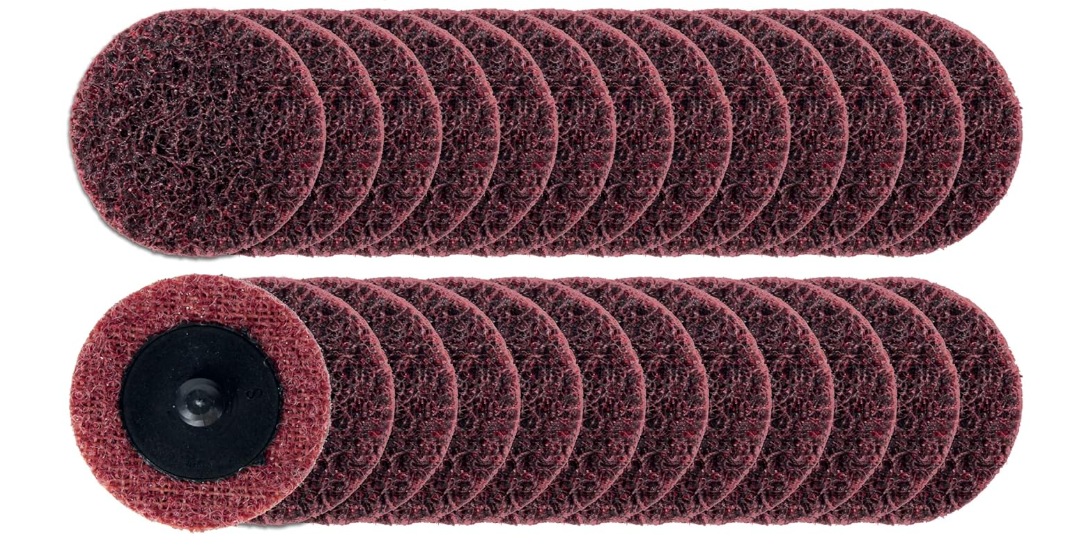
Surface conditioning discs employ non-woven nylon fiber matrices impregnated with abrasive minerals, fundamentally different from bonded abrasive discs. The three-dimensional web structure consists of nylon fibers (typically 6/6 or 6/10 polyamide) mechanically entangled and bonded with phenolic resin. Abrasive particles—aluminum oxide for ferrous metals, silicon carbide for non-ferrous applications—are distributed throughout this matrix at controlled densities.
Grit Grade System:
| Grade | Mineral Load | Primary Application | Surface Finish (Ra) |
|---|---|---|---|
| Coarse | Heavy-duty aluminum oxide | Heavy rust, weld scale removal | 125-250 µin |
| Medium | Balanced mineral distribution | General surface prep, paint removal | 63-125 µin |
| Fine | Light silicon carbide coating | Blending, pre-polish finishing | 32-63 µin |
| Very Fine | Ultra-fine mineral dispersion | Final polish, stainless passivation | 16-32 µin |
The open-web architecture provides continuous self-sharpening as outer fiber layers wear away, exposing fresh abrasive minerals. This contrasts with coated abrasives, where dulled grains remain bonded to the backing, reducing cutting efficiency. For procurement specifications, density ratings (typically 150-300 g/m²) indicate mineral loading—higher densities deliver aggressive cut rates but shorter lifespan.
Rust Removal Application Techniques
Surface Assessment and Disc Selection Protocol
Effective rust removal begins with accurate corrosion classification. Surface rust (Fe₂O₃ oxidation layer <0.5mm depth) responds to medium-grit discs, while pitted corrosion penetrating >2mm into base metal requires coarse-grit aggressive removal followed by progressive refinishing.
Material Substrate Considerations:
- Carbon Steel: Aluminum oxide discs (brown/gray) provide optimal cut rate without excessive heat generation
- Stainless Steel (300-series): Silicon carbide discs prevent iron contamination that causes secondary corrosion
- Cast Iron: Coarse aluminum oxide removes graphitic corrosion layers without smearing
- Galvanized Surfaces: Fine-grit discs preserve zinc coating integrity during light rust removal
For structural applications where metal thickness loss matters, measure remaining wall thickness with ultrasonic gauges before aggressive abrasion. SSPC-SP standards classify surface preparation levels—twist-lock discs typically achieve SP-7 (brush-off blast) to SP-11 (power tool cleaning) equivalents depending on technique.
Operational Parameters for Effective Rust Stripping
Controlled operational parameters determine rust removal efficiency and disc longevity. Angle grinder RPM settings must align with disc diameter and density specifications—overspeeding causes premature fiber breakdown, while insufficient speed reduces cutting action.
Critical Parameter Matrix:
- Tool Speed: 4,500-6,000 RPM for 5″ discs on general rust; 7,000-9,000 RPM for light surface oxidation
- Contact Pressure: 5-8 lbs for coarse discs; 3-5 lbs for medium/fine grades (excessive pressure generates heat without improving removal rate)
- Attack Angle: 15-25° disc tilt maximizes fiber contact area; flat contact causes center loading and premature wear
- Pass Overlap: 40-50% overlap between adjacent passes ensures uniform coverage without redundant abrasion
Implement a cross-hatch pattern—initial passes at 45° to rust grain direction, secondary passes perpendicular—to prevent directional scratching. On vertical surfaces, work bottom-to-top to avoid recontamination from falling debris.
| Rust Type | Recommended Grit | Tool Speed (RPM) | Estimated Removal Rate | Disc Lifespan |
|---|---|---|---|---|
| Surface oxidation (<0.5mm) | Medium | 5,500-6,500 | 0.8-1.2 ft²/min | 45-60 ft² |
| Moderate pitting (0.5-2mm) | Coarse | 4,500-5,500 | 0.4-0.7 ft²/min | 25-35 ft² |
| Heavy scale/mill scale | Extra Coarse | 4,000-5,000 | 0.3-0.5 ft²/min | 15-25 ft² |
| Post-weld discoloration | Fine | 6,000-7,500 | 1.0-1.5 ft²/min | 55-70 ft² |
Heat management becomes critical during extended operations. Maintain 3-5 second contact intervals with 2-second cooling pauses to prevent substrate temperatures exceeding 300°F, where microstructural changes affect base metal properties.
Metal Surface Polishing and Finishing Workflows
Progressive Grit Sequencing for Mirror Finishes
Achieving mirror-finish surfaces (Ra <16 µin) requires systematic grit progression that removes scratches from each previous stage. Skipping intermediate grades leaves deep scratches requiring excessive fine-grit work, reducing efficiency by 40-60%.
Standard Five-Stage Protocol:
- Coarse Stage (80-120 grit equivalent): Remove heavy oxidation, weld spatter, and surface irregularities
- Medium Stage (150-180 grit): Eliminate coarse scratches, establish uniform base texture
- Fine Stage (220-320 grit): Blend medium-grit patterns, prepare for pre-polish
- Very Fine Stage (400-600 grit): Create a semi-reflective surface, remove fine-grit directional marks
- Ultra-Fine Stage (800+ grit): Final polish to specified reflectivity
Between stages, clean surfaces with isopropyl alcohol or acetone to remove embedded abrasive particles that cause cross-contamination. Residual coarse particles dragged by fine-grade discs create random deep scratches requiring rework.
Maintain consistent directional patterns within each stage—circular, linear, or random orbital—then change direction 90° in subsequent stages to identify remaining scratch patterns. This technique, standard in metallographic preparation, ensures complete removal of previous-stage defects.
Specialized Applications: Stainless Steel, Aluminum, and Painted Surfaces
Stainless Steel Passivation Finishing:
Austenitic stainless steels (304, 316) require non-ferrous abrasives to prevent iron contamination. Use silicon carbide discs exclusively, progressing from 120 to 600 grit for pharmaceutical or food-grade equipment. Maintain surface temperatures below 250°F to prevent chromium carbide precipitation that reduces corrosion resistance. Final passivation with citric or nitric acid solutions restores the protective chromium oxide layer.
Aluminum Surface Preparation:
Aluminum’s low melting point (1,220°F) and high thermal conductivity create loading challenges where metal smears across disc fibers. Combat this through:
- Lower contact pressure (2-4 lbs maximum)
- Higher tool speeds (7,000-8,500 RPM) for cooler cutting action
- Frequent disc cleaning with wire brush or compressed air
- Specialized anti-loading stearate-coated discs for production environments
For aerospace applications requiring anodizing prep, achieve 32-63 µin Ra finish with 320-grit discs to ensure uniform oxide layer formation.
Paint Removal and Surface Preparation:
Surface conditioning discs excel at paint stripping without substrate damage. Coarse-grade discs remove multiple paint layers at 1.5-2.0 ft²/min while preserving underlying metal profiles. For powder coating prep, medium-grit discs create 80-125 µin Ra anchor profiles that optimize coating adhesion per SSPC-PA2 standards.
Safety Standards and Operational Compliance
PPE Requirements and OSHA/ANSI Guidelines
Abrasive disc operations generate multiple hazards requiring comprehensive personal protective equipment protocols aligned with OSHA 29 CFR 1910.133 (eye protection) and 1910.134 (respiratory protection).
Mandatory PPE Configuration:
- Eye Protection: ANSI Z87.1+ rated safety glasses with side shields minimum; full-face shields required for overhead work or operations generating heavy particle volumes
- Respiratory Protection: NIOSH-approved P100 particulate filters for metal dust exposure; supplied-air respirators for enclosed spaces where dust concentrations exceed 15 mg/m³ PEL
- Hand Protection: Cut-resistant gloves (ANSI A4 minimum) with leather palms for grip; avoid loose-fitting gloves that catch on rotating equipment
- Hearing Conservation: Double protection (foam inserts + earmuffs) when noise levels exceed 100 dBA, typical of 9,000+ RPM operations
Metal dust composition determines respiratory protection requirements. Stainless steel grinding generates hexavalent chromium (Cr⁶⁺), requiring P100 filtration minimum, while aluminum dust presents combustion hazards in confined spaces necessitating explosion-proof ventilation systems.
Disc Inspection and Replacement Criteria
Implement pre-operational inspection protocols to prevent disc failure incidents. Visual examination should identify:
- Fiber Delamination: Separation between nylon layers indicating resin bond failure
- Center Hole Elongation: Oval distortion >0.030″ prevents secure twist-lock engagement
- Backing Pad Wear: Lug damage or hub cracking compromising mechanical retention
- Contamination: Embedded foreign materials (weld spatter, paint chips) causing vibration
Replace discs when fiber density reduces to 50% of original thickness or when cutting efficiency drops below 60% of new-disc performance. Maximum RPM ratings stamped on backing pads represent absolute limits—never exceed these values even if equipment capabilities allow higher speeds.
| Safety Item | Standard Reference | Inspection Frequency | Non-Compliance Risk |
|---|---|---|---|
| Disc speed rating vs. tool RPM | ANSI B7.1 | Every disc change | Catastrophic disc failure, projectile hazards |
| Backing pad thread engagement | OSHA 1910.243(c) | Daily pre-shift | Disc ejection during operation |
| Guard integrity and positioning | ANSI B7.1 Section 5 | Weekly | Operator exposure to rotating components |
| Ventilation adequacy (dust control) | OSHA 1910.94 | Monthly air sampling | Respiratory disease, combustible dust accumulation |
| PPE condition and fit | OSHA 1910.132(d) | Before each use | Inadequate protection from flying particles |
Maintain disc inventory rotation using first-in-first-out (FIFO) systems to prevent storage degradation. Phenolic resin binders deteriorate over 24-36 months, reducing bond strength and increasing failure risk.
FAQ Module
Q1: What is the typical lifespan of a twist-lock surface conditioning disc in continuous rust removal operations?
Disc lifespan varies significantly based on rust severity, substrate hardness, and operational parameters. For medium-grit discs removing moderate surface rust from carbon steel at recommended speeds (5,500 RPM) and pressure (5-7 lbs), expect 35-50 square feet coverage before performance degradation exceeds 40%. Heavy pitted corrosion reduces this to 20-30 square feet. Coarse-grade discs handling aggressive mill scale removal typically achieve 15-25 square feet. Maximize lifespan by maintaining proper attack angles (15-25°), avoiding excessive pressure that generates heat, and implementing intermittent cooling periods during extended operations. Track cost-per-square-foot metrics across different disc grades and applications to optimize procurement decisions.
Q2: Can twist-lock discs be used on both ferrous and non-ferrous metals without cross-contamination risks?
Cross-contamination presents serious corrosion risks, particularly when switching between carbon steel and stainless steel. Iron particles embedded in disc fibers from carbon steel operations transfer to stainless surfaces, creating localized corrosion cells that compromise passivity. Implement dedicated disc inventories color-coded by substrate type: aluminum oxide (brown/gray) for ferrous metals, silicon carbide (black/green) for stainless and non-ferrous applications. For facilities processing multiple materials, establish separate tool stations with dedicated backing pads to prevent inadvertent mixing. The marginal cost of maintaining separate inventories (typically 15-20% of abrasive budget) is negligible compared to rework costs or product failures from contamination-induced corrosion.
Q3: How do I prevent disc slippage during high-torque applications on heavily corroded surfaces?
Disc slippage under high-torque loads indicates either improper installation or worn backing pad components. Verify twist-lock engagement by attempting manual disc rotation after installation—properly seated discs resist rotation with >20 ft-lbs torque. Inspect backing pad lugs for wear or deformation; replace pads when lug height reduces below 0.080″ or when plastic deformation becomes visible. During aggressive rust removal, reduce contact pressure rather than increasing force—excessive pressure causes fiber compression that reduces cutting efficiency while generating heat that softens backing pad plastics. For extreme applications, specify heavy-duty backing pads with reinforced hubs rated to 15,000+ RPM. Consider upgrading to thread-locking backing pads that incorporate secondary mechanical retention for maximum security in high-vibration environments.
Mastering twist-lock surface conditioning disc applications requires understanding the interplay between abrasive technology, operational technique, and safety compliance. Proper disc selection based on rust severity and substrate type, combined with controlled operational parameters, delivers consistent surface preparation results while maximizing tooling ROI. Industrial facilities adopting standardized protocols for grit sequencing and equipment maintenance achieve superior finish quality and extended consumable lifespan across metalworking applications.
The quick-change capability of twist-lock systems reduces non-productive changeover time by 70-75% compared to traditional mounting methods, directly impacting labor efficiency in high-mix production environments. When procurement decisions incorporate total cost of ownership—including labor savings, reduced disc waste from premature failure, and improved surface quality reducing downstream rework—twist-lock systems demonstrate 25-40% cost advantages over adhesive-backed alternatives despite higher unit prices.
Implementation success depends on comprehensive operator training covering material-specific techniques, progressive grit sequencing principles, and safety protocol adherence. Organizations establishing documented standard operating procedures with visual work instructions report 30-50% reductions in consumable waste while achieving more consistent surface preparation outcomes across multiple operators and shifts.