
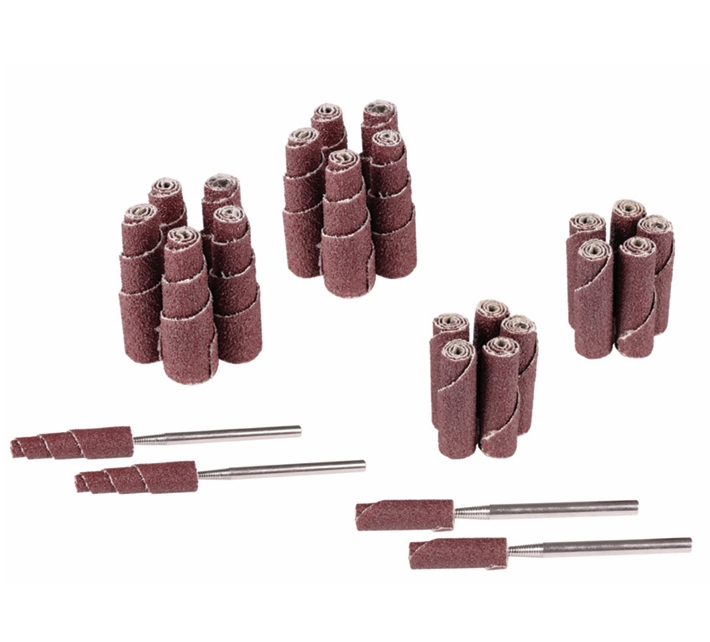
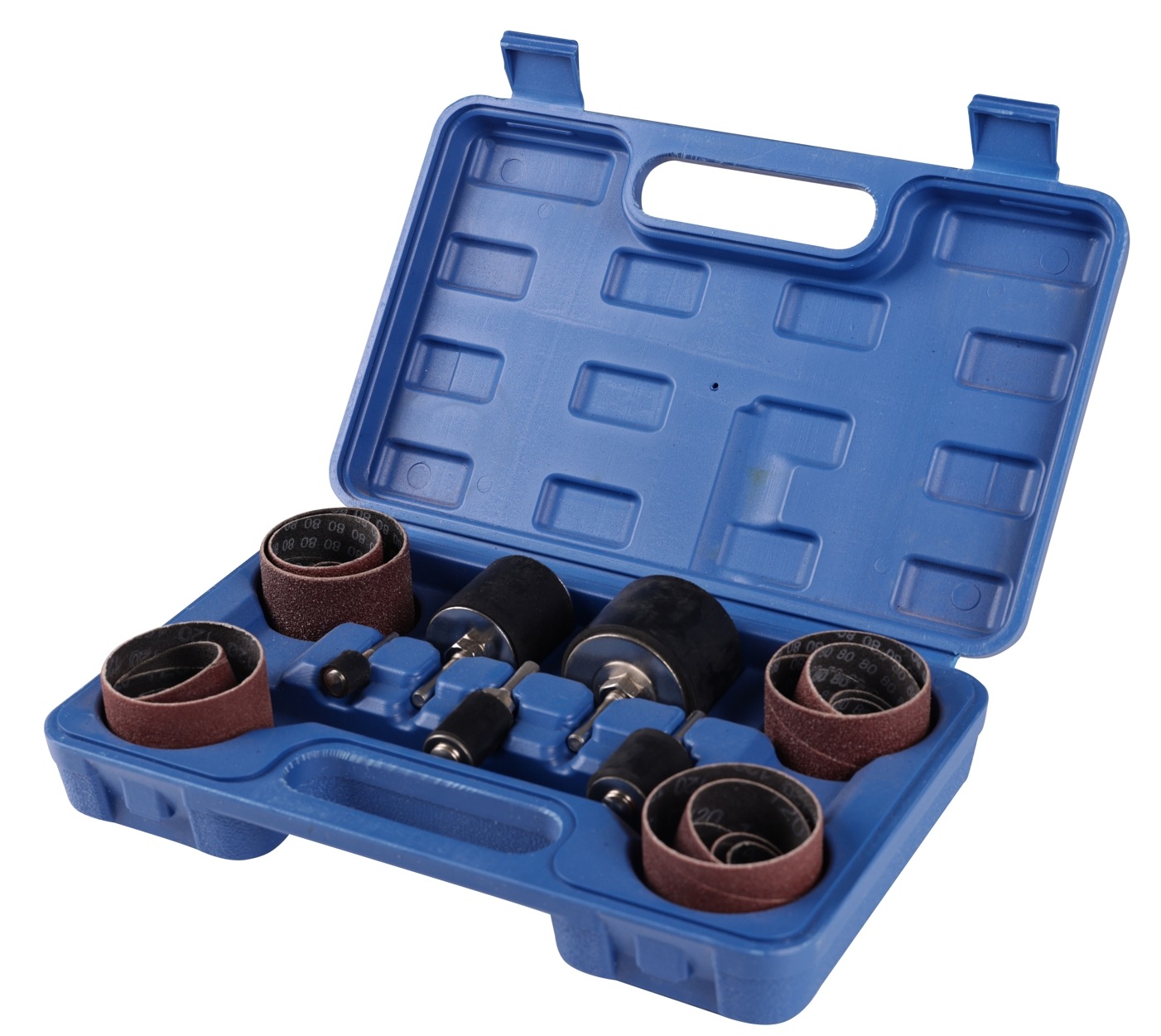
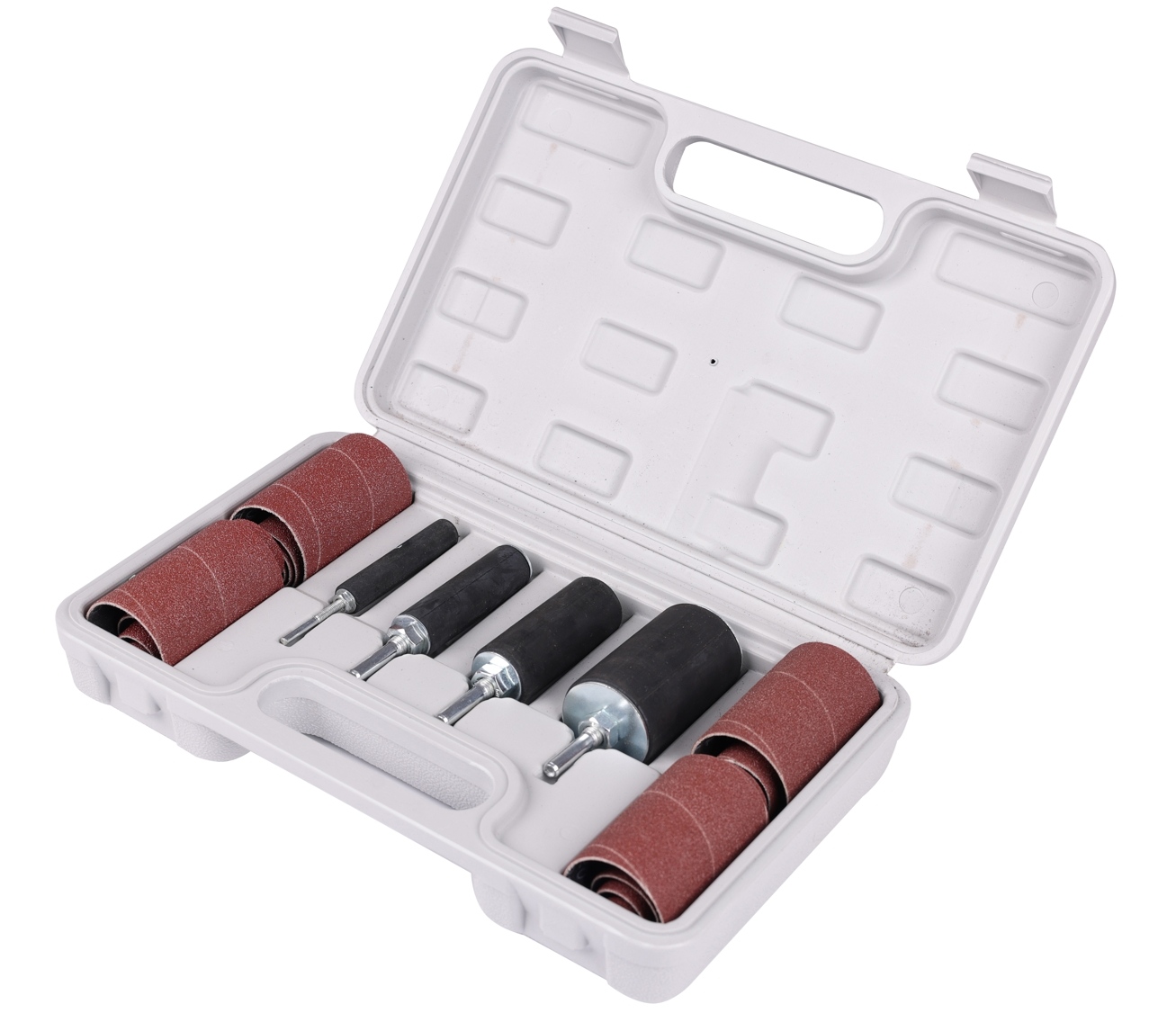
A sanding sleeve is a cylindrical abrasive tool designed for precision sanding, shaping, and finishing, particularly on curved, irregular, or internal surfaces.
According to industrial product data and engineering resources, they are typically made from abrasive grains (such as aluminium oxide), which are bonded to a flexible cloth backing. They are then mounted onto a drum or mandrel for use with power tools.
Due to their ability to conform to complex geometries and deliver consistent material removal, they are widely used in woodworking, metalworking, and automotive applications. These characteristics make sanding sleeves essential for industrial manufacturing and professional workshops alike.
Introduction: Why Sanding Sleeves Matter in Modern Finishing
In precision finishing and surface preparation, achieving smooth, accurate results on complex shapes can be challenging. Traditional sanding tools, such as flat discs or belts, are limited when working on curves, internal edges, or narrow openings. This is where the sanding sleeve comes in handy.
It provides a flexible yet durable abrasive solution that can adapt to intricate geometries without compromising efficiency. When used with a spindle sander, drum sander, or rotary tool, it enables precise and controlled material removal. Manufacturers such as Hongcheng Abrasive have further enhanced sleeve performance by optimising abrasive grain bonding, durability, and consistency, making their products suitable for both industrial-scale and precision applications.
What Is a Sanding Sleeve?
A sanding sleeve is a cylindrical abrasive sleeve that fits over a rotating drum or mandrel. Unlike flat sandpaper, it is specifically designed for rotary motion and contour sanding.
Key characteristics:
- Cylindrical shape for 360° sanding contact
- Flexible backing to conform to curves
- Replaceable design for cost efficiency
- Available in multiple grit sizes
Technically, sanding sleeves function similarly to sanding bands, but they are typically used as replaceable abrasive components mounted on expandable drums.

Structure and Materials of Sanding Sleeves
| Component | Description | Performance Impact |
| Abrasive Grain | Aluminum oxide, ceramic, or zirconia | Determines cutting efficiency |
| Backing Material | Cloth or fiber substrate | Provides flexibility and durability |
| Bonding Layer | Resin adhesive system | Ensures grain retention |
| Cylindrical Form | Seam or overlap design | Enables uniform sanding |
High-quality manufacturers like Hongcheng Abrasive use premium aluminum oxide grains and reinforced cloth backing to improve lifespan and maintain consistent grinding performance.
How Does a Sanding Sleeve Work?
A sanding sleeve rotates at high speed around a drum, enabling abrasive grains to remove material through friction and microcutting actions. This process can be broken down into several stages:
Mounting:
The sleeve is installed onto an expansion drum or mandrel, which holds it securely in place during operation.
Rotation
When powered, the drum rotates, causing the sleeve to spin at high speed.
Material removal
The abrasive grains come into contact with the workpiece, removing material layer by layer.
Surface refinement
Different grit sizes allow for rough shaping or fine finishing, depending on the application.
Due to its cylindrical geometry, the sanding sleeve provides consistent contact across curved surfaces, which is difficult to achieve with flat abrasives.
What Is a Sanding Sleeve Used For?
Sanding sleeves are highly versatile tools used in a variety of industries. Their primary applications include:
Woodworking:
Shaping curved edges and contours, smoothing interior holes and joints, and finishing furniture components.
Metalworking:
Deburring sharp edges, removing weld marks, and preparing surfaces for coating.
Automotive repair:
Surface preparation for painting and rust removal in tight areas.
Plastic and composite processing:
Edge finishing and precision shaping without melting when using advanced abrasives.
Their ability to adapt to irregular surfaces makes them superior to traditional sanding tools for many specialised tasks.
Types of Sanding Sleeves
| Type | Description | Typical Use |
| Cylindrical Sleeves | Standard straight shape | General sanding |
| Conical Sleeves | Tapered design | Narrow or angled surfaces |
| Spiral Sleeves | Overlapping construction | Heavy-duty sanding |
| Ceramic Sleeves | Highperformance abrasive | Industrial applications |
Each type is designed to address specific challenges in sanding and finishing operations.
Key Advantages of Sanding Sleeves
Sanding sleeves, also known as sanding bands or drum sleeves, are cylindrical abrasives designed to fit over rotating drums or spindles. Due to their precision, efficiency, and versatility, they are widely used in woodworking, metalworking, and finishing processes.
- High efficiency in material removal
Continuous rotational sanding
Uniform contact with the workpiece
Impact:
Faster stock removal compared to manual sanding, improving productivity in industrial and workshop settings.
- Consistent surface finish
Even abrasive distribution
Stable sanding pressure
Result:
Produces a smooth and uniform finish, reducing the need for rework.
- Ideal for curved and contoured surfaces
Unlike flat sandpaper, sanding sleeves are perfect for:
- Internal curves
- Rounded edges
- Irregular shapes
Insight:
This makes them essential for furniture making and detailed craftsmanship.
- Wide range of grit options
Available in multiple grit sizes:
- Coarse (40–80 grit): heavy material removal
- Medium (100–150 grit): surface levelling
- Fine (180–320+ grit): finishing
Advantages:
Supports multistage sanding processes with one system.
- Easy replacement and low downtime
Quick to install and remove
Compatible with standard sanding drums
Benefit:
Reduces machine downtime and improves workflow efficiency.
- Cost-effective solution
Long lifespan (depending on material and usage)
Affordable consumables
Insight:
Offers a strong cost-performance ratio for both small workshops and large-scale production.
- Versatility across materials
Sanding sleeves can be used on:
- Wood
- Plastics
- Metals (with the appropriate abrasive type)
- Composites
Benefit: One tool system supports multiple applications.
- Improved control and precision
Mounted on machines such as spindle sanders or drill presses
Controlled speed and pressure
Result:
Greater accuracy compared to hand sanding, especially for detailed workpieces.
- Compatibility with Various Machines
Commonly used with:
- Oscillating spindle sanders
- Drill-mounted sanding drums
- CNC finishing setups
Insight:
Flexible integration into both manual and automated workflows.
- Reduced Operator Fatigue
Machineassisted sanding
Less manual effort required
Impact:
Improves ergonomics and operator productivity.

Grit Selection Guide
| Grit Size | Application | Result |
| 24–60 | Heavy material removal | Rough shaping |
| 80–120 | General sanding | Surface smoothing |
| 150–240 | Fine finishing | Smooth surface |
| 320+ | Polishing preparation | High-quality finish |
Choosing the correct grit is critical for achieving optimal results and avoiding surface damage.
Common Mistakes When Using Sanding Sleeves
Although sanding sleeves are simple tools, if used incorrectly, they can quickly lead to a poor surface finish, premature wear, and reduced efficiency. Many of these issues are similar to those identified in broader abrasive problems in industrial sanding processes.
❌ 1. Applying excessive pressure
Forcing the workpiece onto the sleeve
Trying to speed up material removal
Problem: Overheating, uneven sanding, and faster abrasive wear
Insight:
Excessive pressure is a leading cause of abrasive failure and poor finish quality.
❌ 2. Using the wrong grit size
Starting with a grit that is too fine
Skipping grit progression
Result:
- Inefficient sanding
- Visible scratches or poor finish
Best practice:
Gradually move from coarse to medium to fine.
❌ 3. Using worn or clogged sleeves
Continuing to use dull abrasives
Ignoring material buildup (loading)
Impact:
- Reduced cutting efficiency
- Surface burning or glazing
Insight:
Clogged abrasives significantly reduce performance and lifespan.
- Incorrect machine setup
Problems:
- Poor drum expansion (sleeve not tight)
- Misalignment or imbalance
Best practice:
- Move gradually from coarse to medium to fine. Incorrect machine setup
- Poor drum expansion (sleeve not tight)
- Misalignment or imbalance
Problems:
- Sleeve slipping or uneven sanding
- Vibration and an inconsistent finish
Example:
Improper tension or tracking can lead to slippage and heat buildup.
- Ignoring heat buildup
Continuous sanding without pauses
High-speed operation without cooling
Result:
- Sleeve deformation
- Reduced abrasive life
Insight: Heat is a major factor in abrasive wear and failure.
❌ 6. Poor dust extraction
No vacuum or airflow system
Dust accumulation during sanding
Impact:
- Clogging (loading)
- Reduced efficiency and surface defects
Dust buildup is a known cause of sanding inefficiency and defects.
❌ 7. Uneven pressure or contact
Tilting the workpiece
Sanding only one area of the sleeve
Result:
- Uneven wear
- Irregular surface finish
❌ 8. Using the wrong sleeve type for the material
Using wood sleeves on metal
Using the incorrect abrasive material (e.g., aluminium oxide vs. silicon carbide)
Impact:
- Poor performance
- Faster wear
❌ 9. Skipping Maintenance
Not cleaning drums
Ignoring worn rubber expanders
👉 Result:
- Poor sleeve grip
- Inconsistent sanding
❌ 10. OverSanding
Staying too long in one spot
👉 Impact:
- Surface damage
- Loss of dimensional accuracy
Sanding Sleeve vs Other Abrasive Tools
| Tool Type | Best For | Limitations |
| Sanding Sleeve | Curves, holes, contours | Limited flat surface efficiency |
| Sanding Belt | Large flat areas | Poor for curves |
| Sanding Disc | General-purpose sanding | Less precise on edges |
This comparison highlights the unique role of sanding sleeves in precision applications.
Industry Trends and Innovations
The sanding sleeve and abrasive industry is evolving, with a particular focus on efficiency and durability.
- Advanced Abrasive Materials
Innovations:
Ceramic abrasives
Zirconia alumina
Engineered grain structures
Benefits:
Longer lifespan
Faster cutting performance
- Anticlogging and self-cleaning technology
Opencoat designs
Antiloading coatings
Impact:
Reduced dust buildup
More consistent performance
- Precision manufacturing and consistency
Uniform grit distribution
Improved bonding technology
Result:
Higher-quality finishes and predictable performance
- Automation and CNC integration
Use in automated sanding systems
Integration with CNC and robotic finishing
Trend:
Manual sanding → automated precision finishing
- Smart monitoring and predictive maintenance
Sensors to detect wear
AI-based abrasive life prediction
Research shows that machine learning can detect abrasive wear with high accuracy, improving maintenance timing.
- Eco-friendly and sustainable abrasives
Recyclable backing materials
Reduced chemical usage
Driven by:
Environmental regulations and sustainability goals
- Customisation and application-specific sleeves
Tailored grit combinations
Industry-specific designs (wood, metal, composites)
Benefit: Better performance for specialised applications
- High-speed and highperformance sanding systems
Designed for industrial-scale production
Optimised for durability under high loads
FAQ: Sanding Sleeve
- What is a sanding sleeve used for?
It is used for sanding curved surfaces, internal holes, and irregular shapes in materials such as wood, metal, and plastic.
- What tools use sanding sleeves?
Spindle sanders, drum sanders, die grinders, and rotary tools commonly use sanding sleeves.
- What is the difference between sanding sleeves and sanding bands?
They are essentially the same; sanding sleeves refer to replaceable cylindrical abrasive components mounted on drums.
- How do you choose the right sanding sleeve?
Select based on grit size, material type, and application requirements.
- How long do sanding sleeves last?
Their lifespan depends on material, usage intensity, and abrasive quality.
- Can sanding sleeves be used on metal?
Yes, especially those made with aluminum oxide or ceramic abrasives.
Conclusion
A sanding sleeve is a highly specialised abrasive tool designed for precision sanding of complex surfaces. Thanks to its cylindrical design, flexibility, and versatility, it has become an essential component in modern finishing processes.
From woodworking to industrial metal fabrication, sanding sleeves consistently deliver results where traditional abrasives fall short. Thanks to continuous innovation from manufacturers such as Hongcheng Abrasive, sanding sleeves are becoming increasingly efficient, durable, and adaptable, ensuring their ongoing importance in advanced manufacturing and finishing applications.